

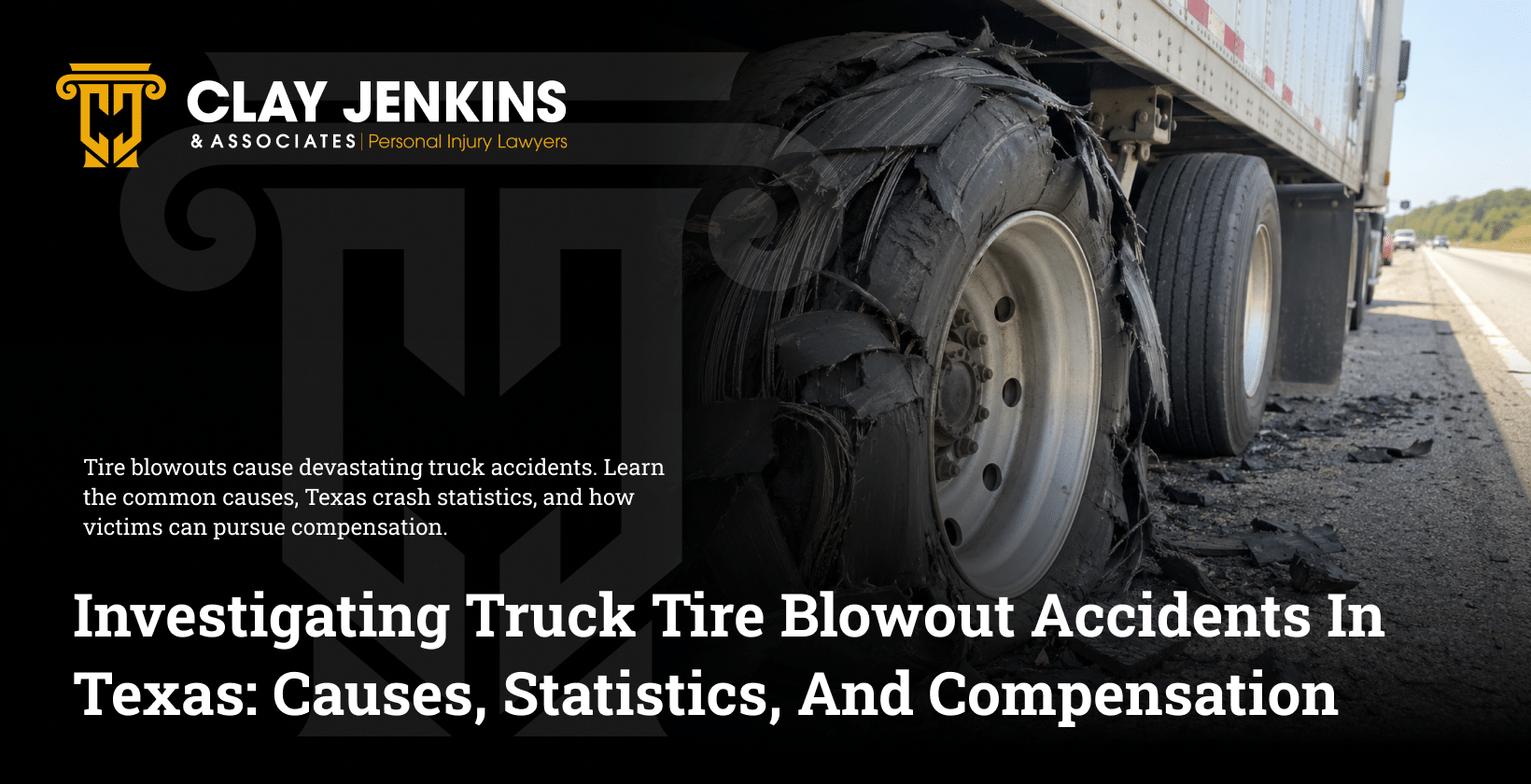
After a truck tire blowout, the truck accident lawyers at Clay Jenkins & Associates investigate what happened to that tire before it failed. Was it underinflated, worn past the federal tread limit, overloaded, or defective when it left the factory? The answer decides whether the claim runs against the driver, the trucking company, a repair shop, or the tire maker.
We represent people across Texas who were hurt when a commercial truck lost a tire, and the first consultation is free. Call (972) 938-1234 to talk with our team.
Truck Tire Blowouts and Texas Road Safety
A tire blowout is a sudden loss of air pressure, and on a truck it often comes with the tread tearing away from the tire body. On a loaded tractor-trailer, a blowout can pull the truck sideways, throw heavy strips of tread into traffic, and leave the driver seconds to react. Federal rules bar any commercial truck from running on a tire with exposed ply or belt material, tread or sidewall separation, or an audible leak (49 C.F.R. § 393.75(a)).
For a free legal consultation, call (972) 938-1234
Why Blowouts Are Especially Dangerous on Texas Highways
Texas trucks cover long distances at highway speed, often in summer heat. The National Highway Traffic Safety Administration warns that sustained high temperatures can make a tire deteriorate and lead to blowouts and tread separation. When a tire fails at speed, the truck driver and everyone nearby have almost no time to respond.
Tire-related crashes on rural Texas roads are far more likely to be fatal. TxDOT’s 2024 crash data records 48 fatal crashes among 2,078 rural crashes where defective or slick tires contributed, compared with 14 fatal crashes among 1,897 urban crashes. Those figures cover every type of vehicle, not only trucks.
How Blowouts Differ From Other Truck Mechanical Failures
Worn brakes or loose steering can give a driver warning signs before they fail. A blowout happens in an instant. It also leaves physical evidence behind: the tire carcass, tread pieces on the road, and the wheel itself. A tire analyst can read that evidence to show whether the tire failed from underinflation, a road hazard, or a manufacturing defect.
A tire failure can also bring in a defendant that other mechanical failures do not. When the tire itself was defective, the manufacturer can be sued under Texas products liability law in Tex. Civ. Prac. & Rem. Code ch. 82, alongside the driver and the trucking company.
Click to contact our personal injury lawyers today
Texas Truck Tire Blowout Statistics
Texas does not publish a separate count of truck tire blowouts. TxDOT does track crashes where the investigating officer listed “defective or slick tires” as a contributing factor, for all vehicle types:
|
Texas, 2024 |
Crashes with defective or slick tires as a factor |
Fatal crashes |
Suspected serious injury crashes |
|
Rural roads |
2,078 |
48 |
96 |
|
Urban roads |
1,897 |
14 |
58 |
|
Statewide |
3,975 |
62 |
154 |
Source: TxDOT, Crash Contributing Factors 2024, based on Texas Peace Officer’s Crash Report data processed as of April 9, 2025. The counts include cars and pickups as well as commercial trucks.
Complete a Free Case Evaluation form now
Statewide Crash Data Involving Tire Failures
Commercial motor vehicles were involved in 39,393 Texas crashes in 2024, including 546 fatal crashes that killed 608 people, according to TxDOT. In Ellis County, where our office is, TxDOT recorded 345 crashes involving commercial vehicles and 6 fatal crashes that year.
Nationally, FMCSA’s analysis of federal fatal crash data lists tires as a vehicle-related factor for 43 large trucks in fatal crashes in 2020. That is about 0.9 percent of the 4,842 large trucks in fatal crashes that year. The federal figure counts only trucks where investigators recorded a tire problem.
High-Risk Corridors and Highways in Texas
No public data ranks Texas highways by tire-blowout crashes. Exposure is highest where trucks spend the most time in heavy traffic. The 2025 Texas Top 100 Congested Road Segments report, based on 2024 data, ranks these segments highest for truck congestion:
- Eastex Freeway (I-69/US 59), Houston: The stretch from SH 288 to I-10 ranks first in the state for truck congestion.
- North Freeway (I-35W/US 287), Fort Worth: The segment from SH 183 to I-30 ranks second.
- I-10/US 90, Houston: The segment between I-45 and US 59 ranks third.
- R.L. Thornton Freeway (I-30/US 67), Dallas: The stretch from the Jefferson Viaduct to SH 78 ranks fourth.
- I-35, Austin: The segment from US 290 to SH 71 ranks fifth, and two more I-35 segments in Austin fall in the truck top 10.
Common Causes of Truck Tire Blowouts
A truck tire failure traces back to how the tire was inflated, loaded, inspected, or made, or to what it struck. Each cause points to a different responsible party.
1. Underinflated or Overinflated Tires
An underinflated tire flexes more than it was built to, and NHTSA lists blowouts and tread separation among the results. Federal rules bar running a truck on a tire whose cold inflation pressure is below what the load requires (49 C.F.R. § 393.75(i)). We also check for overinflation, since a tire run outside the maker’s pressure range is a tire that was not maintained as designed.
2. Worn or Bald Tire Tread
Tread that is worn too thin is easier to puncture and quicker to fail. Federal rules require at least 4/32 of an inch of tread on the front tires of a truck or tractor and at least 2/32 of an inch on the other tires (49 C.F.R. § 393.75(b) and (c)). A tire below those limits should never have left the yard.
3. Overloaded or Improperly Loaded Cargo
Every truck tire has a load rating marked on its sidewall. Federal rules bar carrying more weight on a tire than the sidewall allows, except under a special state permit and then at no more than 50 mph (49 C.F.R. § 393.75(g)). An overloaded truck puts heat and strain on its tires that they were not designed to carry, and an unbalanced load can overload the tires on one side.
4. Defective Tire Manufacturing
Some tires fail because of how they were built, with tread that separates from the steel belts or a weak spot in the sidewall. NHTSA lets anyone check for recalls using the DOT Tire Identification Number on the sidewall. When a defect caused the blowout, the tire manufacturer can be held responsible under Tex. Civ. Prac. & Rem. Code ch. 82.
5. Neglected Pre-Trip Tire Inspections
Before driving, a commercial driver must be satisfied that the truck’s tires are in good working order (49 C.F.R. § 392.7). At the end of each day, the driver must report any tire defect found or reported to them, and the carrier must keep that report for three months (49 C.F.R. § 396.11). A skipped walk-around or an ignored report can be where a blowout case starts.
6. Road Hazards and Debris
Potholes, metal debris, and tread left on the road by other trucks can puncture a tire. A road hazard does not always clear the trucking company, because the question becomes whether a properly maintained tire would have survived the impact. When a government-maintained road defect played a part, the government is entitled to written notice of the claim within six months under Tex. Civ. Prac. & Rem. Code § 101.101.
7. Extreme Texas Heat and Pavement Temperatures
Heat builds inside a tire as it rolls, and Texas summers add to it. NHTSA warns that sustained high temperatures can make a tire deteriorate and lead to blowouts. Federal rules even account for that heat buildup when an inspector checks the pressure of a hot tire (49 C.F.R. § 393.75(i)(2)).
8. Retreaded Tire Failures (Recap Tires)
Retreaded tires are legal on commercial trucks, and federal rules bar them only from the front wheels of buses (49 C.F.R. § 393.75(d)). When a retread separates, the questions turn to the retreader’s process, the age of the original casing, and how the carrier tracked the tire. NHTSA notes that tires become more prone to failure as they age, and aging cannot be judged just by looking at a tire.
9. Improper Tire Mounting or Mismatched Tires
A tire mounted on the wrong rim, paired with a mismatched dual, or installed with poorly torqued wheel fasteners can fail even when the tire itself is sound. We review the shop’s work orders and the tire’s service history. Under Tex. Civ. Prac. & Rem. Code § 82.003(a)(3), a seller that installed a product can be liable when the harm resulted from that installation.
Accident Types Caused by Truck Tire Blowouts
The crash that follows a blowout depends on which tire failed, how fast the truck was moving, and how the driver reacted.
1. Jackknife Accidents
When a tractor tire fails and the driver brakes hard, the trailer can keep moving forward while the cab turns. The trailer swings out to form an L shape across the lanes, and vehicles behind it have nowhere to go.
2. Rollover Crashes
A trailer tire that blows on a curve or ramp can drop one side of a loaded trailer and tip the truck over. A rollover can spill cargo across the highway and crush vehicles in the next lane.
3. Debris Strike Collisions
A failed tire sheds heavy strips of rubber and steel belt at highway speed. Those pieces can smash through a windshield or cause a driver to swerve into another lane. If tread from an earlier failure was left on the road, the carrier that lost it may share fault.
4. Rear-End and Multi-Vehicle Pileups
A truck that suddenly slows or stops in a travel lane after a blowout can be hit from behind. In heavy traffic, one impact can set off a chain of collisions involving many vehicles.
5. Loss of Control Sideswipe Crashes
A front tire blowout can pull a truck hard toward the side of the failed tire. The truck can drift across the lane line and sideswipe a car beside it or force that driver off the road.
Investigating a Truck Tire Blowout Accident in Texas
A blowout investigation starts with the tire itself, and the tire is the piece of evidence most likely to be thrown away. Trucking companies, towing yards, and repair shops can scrap failed tires and wheels. We send preservation letters right away so the carcass, the wheel, and the truck’s records stay intact for inspection.
Evidence Collected at the Crash Scene
The physical evidence from a blowout scatters across the road and disappears fast. The evidence we work to secure includes:
- The failed tire carcass and every tread fragment that can be recovered.
- The wheel, rim, and valve stem from the failed position.
- Photos and measurements of tire marks, gouges, and the debris field.
- The police crash report and the officer’s notes on contributing factors.
- Dash camera video and statements from witnesses and other drivers.
- The DOT Tire Identification Number, which identifies the tire and can be checked against NHTSA recalls.
Role of Black Box and Electronic Logging Data
The truck’s engine control module can record speed, braking, and throttle in the moments around the blowout. That data shows how fast the truck was moving when the tire failed and how the driver responded. Our team collects black-box and ELD data along with the carrier’s inspection reports.
Electronic logging device records show when the driver was on duty and whether there was time for a proper inspection. Carriers must keep those records for at least six months (49 C.F.R. § 395.8(k)), and driver inspection reports for only three months (49 C.F.R. § 396.11). A preservation letter sent early keeps them from being lawfully discarded.
Using Tire Forensic Experts in Your Case
A tire forensic expert examines the failed tire under controlled conditions. Marks on the inner liner, the pattern of the tread separation, and damage to the casing can show whether the tire ran underinflated, struck a road hazard, or had a defect from the factory. That finding decides whether the case is mainly about the carrier’s maintenance or about the tire’s design and manufacture.
A design defect claim carries an added burden in Texas. The injured person must prove a safer alternative design existed that was economically and technologically feasible when the tire left the manufacturer’s control (Tex. Civ. Prac. & Rem. Code § 82.005). An expert’s analysis is how that proof gets built.
Are FMCSA Inspection Records Admissible as Evidence?
Some are and some are not. Federal law bars accident reports that motor carriers must file with the U.S. Department of Transportation, and the department’s own investigation reports on that accident, from use in a civil damages case (49 U.S.C. § 504(f)). Roadside inspection reports, maintenance files, and driver inspection reports are different records, and the judge decides whether each one comes in under the Texas Rules of Evidence. In a commercial truck case, Texas also limits regulation evidence in the first phase of a split trial to violations that are specific and helped cause the injury (Tex. Civ. Prac. & Rem. Code § 72.053).
Who Is Liable for a Truck Tire Blowout Accident?
Several parties touch a truck tire before it fails, and more than one can share the blame. Texas juries assign each party a percentage of responsibility under Tex. Civ. Prac. & Rem. Code § 33.003, and a defendant found more than 50 percent responsible can be held liable for all of the recoverable damages under § 33.013(b).
1. The Truck Driver
A driver who skipped the pre-trip tire check, drove on a tire with a visible bulge or leak, or ignored a tire defect someone reported can be personally responsible. The driver’s speed and reaction after the blowout matter too, because a driver who brakes hard or overcorrects can turn a tire failure into a jackknife or rollover.
2. The Trucking Company
A trucking company must systematically inspect, repair, and maintain its trucks and keep maintenance records for one year (49 C.F.R. § 396.3). Each truck also needs a periodic inspection at least once every 12 months (49 C.F.R. § 396.17). Poor truck maintenance, such as running tires past the tread limit or deferring replacements to save money, is one of the clearest paths to holding a carrier responsible.
The company also answers for its employee driver’s negligence on the job. Under Tex. Civ. Prac. & Rem. Code § 72.054, a company that stipulates the driver was its employee acting within the scope of employment is held liable for the driver’s ordinary negligence through that relationship, while claims about its own maintenance failures stay in the case.
3. The Tire Manufacturer (Product Liability)
A tire maker can be liable when a manufacturing flaw or a design defect caused the blowout. Texas products liability law covers claims based on strict liability, negligence, and breach of warranty (Tex. Civ. Prac. & Rem. Code § 82.001(2)). A design claim requires proof of a safer alternative design under § 82.005.
Manufacturers often point to federal safety standards. When a tire’s design complied with mandatory federal standards, Texas presumes the manufacturer is not liable for that design, but the presumption can be rebutted and does not apply to manufacturing flaws (§ 82.008). Product claims also face a 15-year limit from the date the defendant sold the product, with narrow exceptions (§ 16.012).
4. Third-Party Maintenance Providers
Many carriers send tire work to outside shops and roadside service companies. A shop that mounted the wrong tire, mismatched duals, under-torqued the wheel fasteners, or missed obvious damage can share responsibility. Under § 82.003(a)(3), a seller that installed a product can be liable when the harm resulted from that installation.
5. Cargo Loading Companies
A shipper or loader that overloaded a trailer or stacked weight unevenly can push tires past their rated load. Federal rules bar loading a tire beyond the weight marked on its sidewall without a special permit (49 C.F.R. § 393.75(g)). Loading records, bills of lading, and weigh station tickets show who controlled the load.
Federal and Texas Regulations Governing Truck Tires
Federal Motor Carrier Safety Regulations set the minimum tire standards for commercial trucks, and Texas applies most of them to trucks that never leave the state. A violation of these rules can be strong evidence that a driver or carrier was careless.
FMCSA Tire Safety Standards for Commercial Trucks
The core federal tire rule is 49 C.F.R. § 393.75. It bars running a truck on a tire with exposed ply or belt material, tread or sidewall separation, a flat or audible leak, or a cut that exposes the ply or belts. It sets minimum tread depths of 4/32 of an inch on front tires and 2/32 of an inch on all others.
The same rule bars loading a tire beyond its sidewall rating without a special permit and running on a tire inflated below the pressure the load requires. It also bars speed-restricted tires rated at 55 mph or less from being driven faster than their rating.
Texas DOT Inspection and Compliance Requirements
In Texas, the Department of Public Safety sets the safety rules for commercial trucks, not TxDOT. These are the inspection and compliance duties that apply to tires:
- State adoption of federal rules: Texas DPS adopts the federal safety regulations by reference and applies them to intrastate trucks over 26,000 pounds (37 Tex. Admin. Code § 4.11).
- Annual inspection: Every commercial truck needs a periodic inspection at least once every 12 months, and a qualifying state inspection program can satisfy it (49 C.F.R. § 396.17).
- Pre-trip check: The driver must be satisfied that the tires are in good working order before driving (49 C.F.R. § 392.7).
- Driver inspection reports: Tire defects found or reported to the driver must be written up at the end of the day, and the reports kept for three months (49 C.F.R. § 396.11).
- Systematic maintenance: The carrier must inspect, repair, and maintain its trucks and keep the records for one year (49 C.F.R. § 396.3).
Injuries Commonly Sustained in Tire Blowout Crashes
The size and weight of a commercial truck mean a blowout crash can cause serious injuries, even at moderate speed. These are among the injuries a blowout crash can cause.
1. Traumatic Brain Injuries
The CDC describes a traumatic brain injury as an injury that affects how the brain works, and a bump, blow, or jolt to the head can cause one. In a truck crash, the head can strike the window or steering wheel, or the brain can move violently inside the skull. Symptoms can affect how a person thinks, feels, and sleeps, so the claim needs records from doctors who treat brain injuries.
2. Spinal Cord Injuries and Paralysis
The National Institute of Neurological Disorders and Stroke lists motor vehicle crashes among the most common causes of spinal cord injury in the United States. Damage to the cord can change feeling, movement, and strength below the injury. A complete injury cuts off nerve communication below the injury site, while an incomplete injury leaves some signals intact.
3. Broken and Crushed Bones
The crushing force of a truck impact or rollover can fracture arms, legs, ribs, hips, and the pelvis. Crush injuries can require multiple surgeries, hardware, and months of physical therapy before a person can return to work.
4. Internal Organ Damage
The force of a truck collision can injure organs in the chest and abdomen. These injuries are diagnosed with imaging and examination at a hospital, which is one reason to get checked the same day even if you feel able to walk away.
5. Lacerations from Tire Debris
Strips of tread and steel belt thrown from a failed tire can break through a windshield or side window. Deep cuts can leave lasting scars, and Texas law lets a jury award damages for disfigurement (Tex. Civ. Prac. & Rem. Code § 41.001(12)).
6. Burns and Fire-Related Injuries
A rollover or a collision that ruptures a fuel tank can start a fire. Burn injuries can require skin grafts, long hospital stays, and reconstructive surgery.
7. Wrongful Death
When a blowout crash takes a life, the surviving spouse, children, and parents of the person who died can bring a wrongful death claim under Tex. Civ. Prac. & Rem. Code § 71.004. That suit must be filed within two years of the date of death under § 16.003(b).
Compensation Available to Texas Blowout Accident Victims
Texas law divides compensation into economic damages for financial losses, noneconomic damages for personal losses, and exemplary damages that punish the worst conduct (Tex. Civ. Prac. & Rem. Code § 41.001). A blowout claim can include all three when the evidence supports it.
Medical Expenses and Future Care Costs
Recovery for medical care is limited to the amount actually paid or incurred by you or on your behalf (§ 41.0105). A claim for medical expenses can include:
- Emergency transport, emergency room care, and hospital stays.
- Surgery, imaging, and specialist care.
- Physical, occupational, and cognitive therapy.
- Medication, medical equipment, and home modifications.
- Future care your doctors expect you to need.
Lost Wages and Diminished Earning Capacity
Lost wages cover the paychecks you missed while recovering. When an injury keeps you from returning to the same work, the claim also covers the reduced ability to earn in the future, which Texas law treats as a future loss of earnings (§ 41.001(10)). Pay records, tax returns, and testimony from employers and vocational experts support this part of the claim.
Pain and Suffering and Non-Economic Damages
Noneconomic damages cover the personal toll of the crash. Texas law lists physical pain and suffering, mental or emotional anguish, disfigurement, physical impairment, loss of companionship, and loss of enjoyment of life among them (§ 41.001(12)). No formula sets these amounts, so the evidence of how the injury changed your daily life matters.
Can Punitive Damages Be Awarded in Texas?
Yes, in limited cases. Texas calls them exemplary damages, and they require clear and convincing evidence of fraud, malice, or gross negligence, plus a unanimous jury (Tex. Civ. Prac. & Rem. Code § 41.003). Gross negligence means conduct involving an extreme degree of risk that the defendant knew about and ignored (§ 41.001(11)), and a carrier that kept a truck running on tires it knew were unsafe can fit that definition. The award is capped at the greater of $200,000 or two times economic damages plus noneconomic damages of up to $750,000 (§ 41.008(b)).
How a Texas Truck Accident Attorney Can Help
After a blowout, the trucking company and the tire maker each have reasons to blame someone else. Our Waxahachie truck accident lawyers handle cases across Texas and identify every party whose decisions put that tire on the road. Two lawyers are assigned to each case at Clay Jenkins & Associates, along with a paralegal and support staff.
Preserving Evidence Before It Disappears
The tire, the wheel, and the truck’s records can be scrapped or lawfully discarded within months. These are the steps we take first:
- Send preservation letters to the carrier, the towing company, and any repair shop holding the truck.
- Secure the failed tire, tread fragments, and wheel for a joint inspection.
- Request ELD data, which carriers must keep for at least six months, and engine control module data.
- Request maintenance records, which carriers must keep for one year, and driver inspection reports, which they must keep for three months.
- Collect tire purchase, retread, and service records and check the Tire Identification Number for recalls.
Negotiating With Trucking Company Insurers
A blowout claim can involve the carrier’s insurer, a repair shop’s insurer, and a tire manufacturer’s defense team. Each will argue that someone else caused the failure. We build the case on the physical evidence and the records, send a demand that accounts for your future care, and prepare the case for trial if the offers fall short.
Common Mistakes to Avoid After a Blowout Accident
A few early missteps can weaken a strong blowout claim. Avoid these:
- Letting the tire disappear: A failed tire left at the tow yard can be scrapped, and with it the best evidence of what went wrong.
- Giving a recorded statement: The carrier’s adjuster can use your words to shift blame onto you.
- Delaying medical care: A gap in treatment lets the insurer argue something else caused your injuries.
- Signing a quick release: A signed release generally ends the claim, even if your injuries turn out to be worse.
- Posting about the crash online: Photos and comments can be used to question your injuries.
- Waiting to call an attorney: Driver inspection reports can be discarded after three months, and the filing deadline keeps running.
Steps to Take Immediately After a Tire Blowout Crash in Texas
What you do in the first hours and days after a blowout crash protects your health and your claim. When you are able, take these steps:
- Call 911 so police and paramedics respond and the crash is documented.
- Get medical care the same day, even if you feel all right.
- Photograph the truck, the failed tire, tread pieces on the road, and your vehicle, if it is safe to do so.
- Write down the trucking company’s name, the numbers on the cab door, and witness contact information.
- Decline to give a recorded statement to the trucking company’s insurer.
- Contact a truck accident attorney so the tire and records are preserved.
What Should I Do If a Truck Tire Blowout Caused My Accident in Texas?
Get medical care, document the scene if you can, and contact a truck accident attorney quickly. The failed tire is the most important piece of evidence, and the carrier or tow yard can scrap it. An attorney can send preservation letters and arrange an inspection before it is gone.
How Long Do I Have to File a Truck Accident Claim in Texas?
Most Texas truck accident lawsuits must be filed within two years of the crash, under Tex. Civ. Prac. & Rem. Code § 16.003. A wrongful death suit must be filed within two years of the date of death. If a government road defect was involved, the government is entitled to written notice within six months (§ 101.101), and product claims against a tire maker face a 15-year limit from the date of sale (§ 16.012).
Can I Sue the Tire Manufacturer After a Blowout Accident?
Yes, when a manufacturing flaw or design defect caused the tire to fail. Texas products liability claims can rest on strict liability, negligence, or breach of warranty (Tex. Civ. Prac. & Rem. Code § 82.001(2)). A design defect claim also requires proof of a safer alternative design (§ 82.005), so a tire forensic expert’s analysis is central to the case.
How Does Texas Comparative Fault Law Affect My Compensation?
The jury assigns a percentage of responsibility to everyone who contributed to the crash, including you. Your damages are reduced by your percentage (Tex. Civ. Prac. & Rem. Code § 33.012(a)), and you recover nothing if your share is more than 50 percent (§ 33.001). When the injured driver did nothing to cause the tire failure, the fight is over how fault is split among the carrier, the repair shop, and the tire maker.
Does Comparative Fault Apply If the Truck Driver Was Unaware of the Tire Defect?
Yes. The jury still divides responsibility among every party that contributed, under Tex. Civ. Prac. & Rem. Code § 33.003. A driver who could not have known about a hidden defect may receive little or no share of fault, which can shift more of it to the manufacturer. A products liability claim against the tire maker does not depend on what the driver knew.
What Evidence Is Most Important in a Tire Blowout Lawsuit?
The failed tire comes first, along with the wheel and any tread fragments. After that, the carrier’s maintenance records, driver inspection reports, ELD data, and tire purchase and retread records show whether the tire should have been on the truck at all. A tire forensic expert ties that evidence together.
Contact Us Today
If a truck tire blowout injured you or someone in your family, the truck accident lawyers at Clay Jenkins & Associates can review the crash, confirm your deadline, and explain what Texas law allows you to recover. The consultation is free and confidential, and you can call 24/7.
Sources
- TxDOT, Crash Contributing Factors 2024
- TxDOT, Commercial Motor Vehicle (CMV) Involved Crashes and Injuries by County 2024
- FMCSA, Large Trucks in Fatal Crashes by Vehicle-Related Factors, 2018–2020 (FARS data)
- Texas A&M Transportation Institute, 2025 Texas Top 100 Congested Road Segments
- Federal Motor Carrier Safety Regulations, 49 C.F.R. Parts 392, 393, 395, and 396, eCFR
- 49 U.S.C. § 504, Legal Information Institute
- Texas Civil Practice and Remedies Code, Chapter 82 (Products Liability), Texas Legislature
- Texas Civil Practice and Remedies Code, Chapters 16, 33, 41, 71, 72, and 101, Texas Legislature
- 37 Tex. Admin. Code § 4.11, Texas Department of Public Safety
- NHTSA, Tires
- CDC, About Traumatic Brain Injury
- National Institute of Neurological Disorders and Stroke, Spinal Cord Injury
Call or text (972) 938-1234 or complete a Free Case Evaluation form