



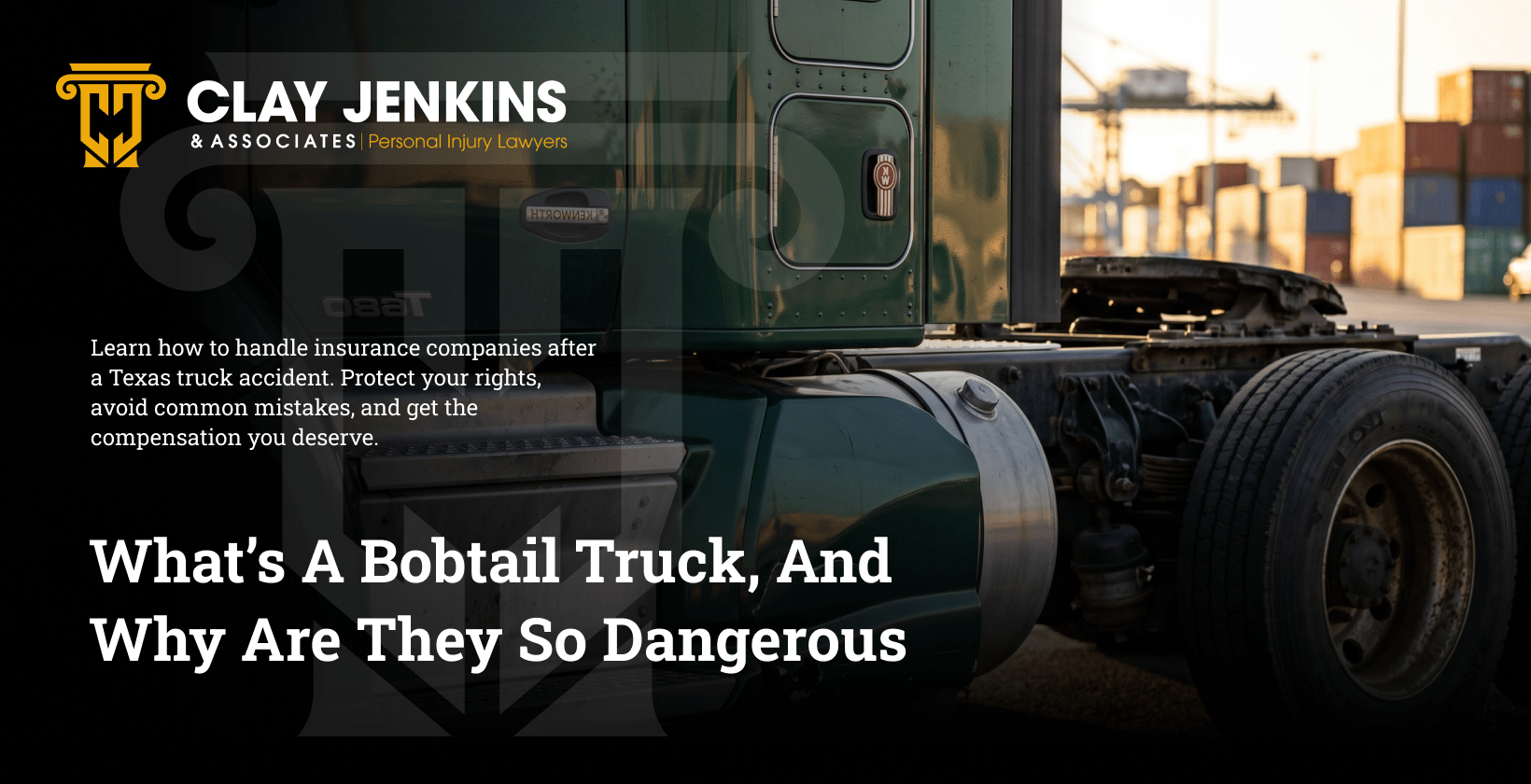
What’s a bobtail truck, and why does it pose such an outsized threat to everyone sharing Texas roads? A bobtail truck is a semi-truck operating without its trailer attached, and dangerous handling characteristics make these vehicles far more hazardous than most motorists realize. Understanding the risks empowers injured victims to pursue the compensation they deserve.
What Is a Bobtail Truck?
A bobtail truck is a tractor-trailer unit traveling without a trailer connected to its rear coupling. The term originates from the shortened, stubby appearance the cab takes on when operating independently. Drivers commonly operate bobtail trucks when repositioning between loads, returning to a terminal after delivery, or transporting the cab for maintenance. Despite appearances, bobtail trucks are not simply smaller, safer vehicles. Their dramatically reduced weight over the rear axles creates profoundly unpredictable handling, extended stopping distances, and dangerous instability under braking, making them disproportionately treacherous compared to fully loaded combinations traveling at identical speeds.
For a free legal consultation, call (972) 938-1234
Why Are Bobtail Trucks So Dangerous on the Road?
Bobtail trucks are deceptively hazardous precisely because their unloaded condition creates handling and braking characteristics that contradict what most drivers expect from large commercial vehicles.
- Reduced Rear Traction: Without trailer weight pressing down on the drive axles, rear wheels lose significant grip and skip unpredictably during braking maneuvers.
- Extended Stopping Distances: Bobtail trucks require dramatically longer distances to stop safely because braking systems are calibrated for fully loaded operation, not lightweight solo running.
- Increased Jackknife Risk: The severe weight imbalance between the heavy front cab and the unweighted rear axles creates extreme susceptibility to jackknifing during sudden braking or sharp cornering.
- Poor Wet Weather Performance: Rain-slicked Texas roads compound rear axle traction deficits, making skidding, spinning, and complete loss of directional control far more probable during precipitation.
- Driver Overconfidence: Many operators underestimate bobtail instability, applying braking habits developed for loaded trucks and triggering catastrophic loss-of-control events on congested highways.
Physics Behind Bobtail Truck Instability
The physics behind bobtail truck instability reveal why these vehicles behave so treacherously despite their reduced size. A fully loaded tractor-trailer distributes enormous weight across multiple axles, pressing drive tires firmly against the pavement and generating the friction necessary for controlled braking. When the trailer is removed, roughly 30,000 pounds of stabilizing downforce disappears from the rear axles. The braking system, designed to handle fully loaded weights, now applies far too much force to lightly weighted rear wheels, causing them to lock and skip rather than roll. This physics mismatch transforms routine braking into a genuine loss-of-control hazard that even experienced operators struggle to manage safely on Texas roadways.
Common Types of Bobtail Truck Accidents
Common bobtail truck accidents follow predictable patterns rooted in the vehicle’s inherent instability, providing critical insight into how negligence occurs and who bears legal responsibility.
- Rear-End Collisions: A bobtail truck’s extended stopping distances frequently result in violent rear-end impacts when traffic slows suddenly ahead of an insufficiently cautious operator.
- Jackknife Accidents: Sudden braking causes the lightweight rear axles to lock and swing outward violently, sweeping across multiple lanes and crushing adjacent vehicles with devastating force.
- Underride Accidents: When smaller passenger vehicles collide with a bobtail truck’s rear, the car slides beneath the cab’s undercarriage, producing catastrophic occupant injuries and frequent fatalities.
- Rollover Crashes: The top-heavy, unbalanced weight distribution of a bobtail cab makes rollover events during sharp turns, evasive maneuvers, or high-speed highway exits alarmingly common.
- Lane Departure Crashes: Reduced rear stability and wind sensitivity cause bobtail trucks to drift unpredictably across lane boundaries, sideswiping adjacent vehicles with minimal warning.
Click to contact our personal injury lawyers today
Federal Regulations Governing Bobtail Operations
Federal regulations governing bobtail operations establish the baseline safety standards commercial truck operators must satisfy even when traveling without a trailer. The Federal Motor Carrier Safety Administration (FMCSA) imposes comprehensive requirements covering driver qualifications, hours of service, vehicle inspections, and equipment maintenance that apply regardless of whether the tractor is loaded or operating as a bobtail. Texas additionally enforces state-level commercial vehicle regulations under the Texas Department of Motor Vehicles and the Texas Department of Public Safety. Violations of these federal and state mandates can constitute negligence per se in personal injury litigation, significantly strengthening an injured victim’s liability claim against the driver, carrier, or both.
FMCSA Hours of Service Rules
FMCSA Hours of Service rules limit driving time to reduce fatigue-related bobtail accidents on Texas roads.
- 11-Hour Driving Limit: Carriers may drive a maximum of 11 hours after completing 10 consecutive hours completely off duty.
- 14-Hour On-Duty Window: Drivers cannot operate beyond the 14th consecutive hour after coming on duty, regardless of breaks taken.
- 30-Minute Break Requirement: After accumulating 8 cumulative hours of driving, operators must take a mandatory 30-minute off-duty rest break.
- 60/70-Hour Weekly Limits: Drivers are prohibited from operating after reaching 60 on-duty hours in 7 days or 70 hours in 8 consecutive days.
Complete a Free Case Evaluation form now
Who Can Be Held Liable in a Bobtail Truck Accident?
Who can be held liable in a bobtail truck accident extends well beyond the driver alone. Texas law recognizes multiple potentially responsible parties, and identifying every viable defendant is critical to recovering full compensation. Trucking companies bear vicarious liability for employee negligence and independent liability for negligent hiring, training, and supervision. Maintenance contractors may share responsibility when mechanical failures contributed to the crash. In some cases, vehicle or component manufacturers face strict products liability exposure for defective equipment. An experienced attorney investigates all contributing factors thoroughly, ensuring no liable party escapes accountability for the catastrophic harm their negligence produced.
Determining Liability: Driver vs. Trucking Company
Liability in bobtail accidents frequently falls on both the individual driver and their employer simultaneously, and distinguishing between the two requires careful legal analysis of employment status, operational control, and regulatory compliance.
| Factor | Driver Liability | Trucking Company Liability |
|---|---|---|
| Employment Status | Applies to employees and contractors | Applies when driver is a direct employee |
| Negligent Acts | Speeding, distracted driving, fatigue | Negligent hiring, inadequate training |
| Regulatory Violations | HOS violations, improper operation | Fleet maintenance failures, policy violations |
| Respondeat Superior | Individual fault | Vicarious liability for employee actions |
| Independent Contractor | Personal liability | May still apply under lease agreements |
Your Legal Rights After a Bobtail Truck Accident
Your legal rights after a bobtail truck accident are protected under Texas law, which provides injured victims with meaningful avenues to pursue full and fair compensation from all negligent parties.
- Right to Pursue Compensation: Texas law entitles injured victims to recover economic and non-economic damages from every party whose negligence contributed to causing the accident and resulting injuries.
- Right to Legal Representation: You have an unconditional right to retain an attorney before speaking with any insurance adjuster, trucking company representative, or opposing legal counsel.
- Right to Refuse Early Settlement: You are never obligated to accept an insurer’s initial settlement offer, and doing so prematurely often forfeits compensation for future medical expenses and long-term losses.
- Right to File Suit: If negotiations fail to produce fair compensation, you retain the absolute right to file a personal injury lawsuit in Texas civil court and present your case before a jury.
What to Do Immediately After a Bobtail Truck Collision
What you do immediately after a bobtail truck collision directly shapes the strength of your injury claim and the compensation ultimately recoverable under Texas law.
- Call 911 Without Delay: Summoning law enforcement and emergency medical services ensures the scene is officially documented and that your injuries receive immediate professional evaluation.
- Photograph Everything Possible: Capturing vehicle positions, road conditions, skid marks, signage, and visible injuries before the scene is cleared creates irreplaceable contemporaneous evidence.
- Collect Driver and Carrier Information: Recording the driver’s license, carrier name, insurance details, and truck identification numbers establishes the essential identifying data needed to pursue all liable parties.
- Seek Medical Evaluation Immediately: Visiting an emergency room or urgent care facility promptly generates official medical records directly linking your injuries to the collision, a connection insurers will otherwise dispute.
- Contact a Truck Accident Attorney: Retaining experienced legal counsel before communicating with any insurance company protects your rights and prevents damaging early missteps.
Common Mistakes That Can Hurt Your Bobtail Accident Case
Common mistakes after a bobtail accident are easily made under the stress of serious injury, yet each one can profoundly diminish the compensation you are entitled to recover.
- Providing Recorded Statements: Giving recorded statements to insurance adjusters without legal representation routinely produces admissions that are strategically repurposed to undermine your claim’s value.
- Accepting the First Settlement Offer: Initial settlement offers rarely account for future surgeries, ongoing rehabilitation, lost earning capacity, or the full scope of non-economic damages you are entitled to recover.
- Delaying Medical Treatment: Gaps between the accident date and your first medical visit allow insurers to credibly argue your injuries were unrelated to or predated the bobtail truck collision.
- Posting on Social Media: Activity photos, location check-ins, and casual comments published after the accident routinely contradict injury claims and provide defense attorneys with powerful impeachment material.
- Missing the Statute of Limitations: Texas imposes a two-year filing deadline for personal injury claims. Missing it permanently extinguishes your right to compensation regardless of liability strength.
How Truck Accident Attorneys Build Strong Bobtail Cases
How truck accident attorneys build strong bobtail cases involves a methodical, multi-layered investigative approach that goes far beyond what injured victims can accomplish independently. Experienced counsel immediately issues spoliation letters demanding preservation of electronic logging device data, black box recordings, maintenance records, and driver qualification files before carriers purge them. Attorneys retain accident reconstruction specialists, biomechanical experts, and commercial trucking safety consultants to establish exactly how the crash occurred and why. Parallel investigation of the carrier’s safety history, hiring practices, and regulatory compliance record frequently uncovers systemic negligence that dramatically amplifies case value and litigation leverage.
Evidence Collection and Expert Witnesses
Thorough evidence collection and credible expert witnesses are the twin pillars upon which successful bobtail truck accident cases are constructed.
- Electronic Logging Device Data: ELD records objectively document the driver’s hours of service compliance, speed history, and operational patterns immediately preceding the catastrophic collision.
- Event Data Recorder Downloads: Black box data captures precise vehicle speed, braking force, steering input, and throttle position in the critical seconds before impact, often proving negligence conclusively.
- Accident Reconstruction Experts: Qualified engineers analyze physical evidence, vehicle damage patterns, and road conditions to scientifically reconstruct how the bobtail accident occurred and who caused it.
- Medical Expert Witnesses: Treating physicians and independent medical examiners establish the nature, severity, and long-term consequences of your injuries with the clinical authority juries find persuasive.
Compensation Available in Bobtail Truck Accident Cases
Compensation available in bobtail truck accident cases under Texas law encompasses a broad range of economic and non-economic damages designed to make injured victims whole. Economic damages cover all quantifiable financial losses, including emergency medical treatment, hospitalization, surgical procedures, physical rehabilitation, future care costs, lost wages, and diminished earning capacity. Non-economic damages address the profound personal toll of serious injury, including physical pain and suffering, emotional distress, disfigurement, and loss of enjoyment of life. In cases involving egregious carrier negligence or deliberate regulatory disregard, Texas courts may also award exemplary damages. A skilled truck accident attorney calculates the full present and future value of your losses to ensure no recoverable category is overlooked or undervalued during negotiations.
When to Contact a Truck Accident Attorney
When to contact a truck accident attorney after a bobtail collision is straightforward: immediately. Critical evidence including ELD data, black box recordings, and driver logs is routinely overwritten or legally purged within days of an accident. Trucking companies dispatch their own investigators to crash scenes almost immediately, building their defense before most victims have left the hospital. Early attorney involvement allows counsel to preserve indispensable evidence, prevent damaging communications with insurers, and begin constructing a comprehensive liability case while facts remain fresh. Delaying legal consultation, even briefly, can permanently compromise the strength of your claim and the compensation ultimately recoverable.
How Long Do I Have to File a Lawsuit After a Bobtail Truck Accident?
How long you have to file a lawsuit after a bobtail truck accident in Texas is governed by the two-year statute of limitations under Texas Civil Practice and Remedies Code § 16.003. This deadline runs from the accident date. Claims against government entities may trigger notice requirements as short as six months. Missing the deadline permanently bars recovery regardless of how compelling your evidence may be.
Can I Sue If I Was Partially at Fault for the Bobtail Accident?
You can still sue and recover compensation even if you were partially at fault for the bobtail accident. Texas applies modified comparative fault rules under Texas Civil Practice and Remedies Code § 33.001, permitting recovery so long as your assigned fault percentage does not exceed 50%. Your total damages award is reduced proportionately by your share of responsibility. Insurers routinely attempt to inflate victim fault percentages to minimize payouts, making aggressive legal representation essential to protecting the full value of your claim.
What If the Bobtail Driver Was an Independent Contractor?
When the bobtail driver was an independent contractor, liability analysis becomes more complex but does not eliminate the trucking company’s potential responsibility. Texas courts examine the degree of operational control the carrier exercised over the driver, the terms of any lease or service agreement, and whether the carrier’s negligent policies contributed to the crash. Under federal trucking regulations, carriers who lease equipment from owner-operators may still bear significant liability regardless of contractor classification. An experienced attorney scrutinizes these relationships thoroughly to ensure the trucking company cannot use contractor status as a shield against accountability.
How Much Does It Cost to Hire a Truck Accident Lawyer?
Hiring a truck accident lawyer at Clay Jenkins & Associates costs nothing upfront. The firm handles bobtail truck accident cases on a contingency fee basis, meaning legal fees are only owed if compensation is successfully recovered on your behalf. You pay nothing unless your case wins.
What If My Insurance Company Offers a Quick Settlement?
When your insurance company offers a quick settlement after a bobtail truck accident, treat it with caution. Early offers are strategically designed to resolve claims before the full scope of your injuries, future medical needs, and long-term losses is known. Accepting prematurely waives your right to additional compensation. Consult an attorney before signing anything.
Contact Us Today
If you or a loved one suffered injuries in a bobtail truck accident, the experienced legal team at Clay Jenkins & Associates is ready to fight for the fair compensation you deserve. Do not let insurance companies and trucking corporations dictate the value of your claim. Schedule a free consultation with a dedicated truck accident attorney at Clay Jenkins & Associates today and take the first step toward justice.
Call or text (972) 938-1234 or complete a Free Case Evaluation form