


Overloading a truck is dangerous because it pushes a commercial vehicle far beyond the mechanical limits it was designed to handle. When trucks carry excessive cargo weight, drivers lose control more easily, stopping distances increase dramatically, and the risk of a catastrophic crash rises sharply. Every year, overloaded commercial trucks contribute to thousands of serious accidents across Texas and the rest of the United States. Victims often suffer severe, life-altering injuries, and consequences can be permanent or fatal. Understanding why truck overloading presents such a critical safety hazard is essential for anyone who regularly shares the road with large commercial vehicles in Texas.
The Serious Problem of Truck Overloading
The serious problem of truck overloading affects every driver who shares a public road with a commercial carrier. A standard semi-truck can legally weigh up to 80,000 pounds under federal law, yet carriers and shippers sometimes load trucks beyond legal limits to maximize short-term profit. When financial pressures override safety, the results can be devastating. Overloaded trucks are harder to control, slower to stop, and more likely to suffer critical mechanical failures during a trip. These failures do not only endanger the truck driver; they put every nearby motorist, cyclist, and pedestrian at serious risk. The problem is compounded by the fact that overloaded trucks may look no different from properly loaded ones, making it impossible for other drivers to recognize the danger until it is far too late to react.
For a free legal consultation, call (972) 938-1234
Texas and Federal Weight Limits
Texas and federal weight limits exist to protect infrastructure and road safety. Both sets of rules apply to commercial trucks operating in the state, and violations of either can result in fines, liability, and deadly accidents.
| Weight Category | Federal Limit | Texas Limit |
| Gross Vehicle Weight (GVW) | 80,000 lbs | 80,000 lbs |
| Single Axle Weight | 20,000 lbs | 20,000 lbs |
| Tandem Axle Weight | 34,000 lbs | 34,000 lbs |
| Tridem Axle Weight | N/A | 42,000 lbs |
| Steer Axle Weight | 12,000 lbs | 12,000–20,000 lbs |
| Bridge Formula (variable) | Applies | Applies |
Texas State Weight Limits
Texas state weight limits are governed by the Texas Department of Motor Vehicles (TxDMV) and the Texas Transportation Code. While Texas generally follows the federal 80,000-pound gross vehicle weight limit, the state has its own axle weight rules that apply to vehicles operating exclusively within state borders. Texas also issues oversize and overweight permits that allow carriers to legally transport heavier loads under specific conditions, including approved routes, escort vehicles, and time-of-day restrictions. Carriers who haul without obtaining required permits face serious civil and criminal penalties. More critically, trucks exceeding legal weight limits without permits pose a substantial danger to other drivers, as the vehicle’s braking, steering, and structural components are not rated for the additional load.
How Overloading Affects Truck Performance
How overloading affects truck performance is a matter of basic physics. A truck’s brakes, suspension, tires, steering components, and frame are all engineered to function within a defined weight range. When a load exceeds that range, every system on the vehicle is forced to perform beyond its design capacity. Suspension components wear faster and may fail without warning. Steering becomes sluggish and less responsive, making it difficult for drivers to react quickly to road hazards. The added stress placed on the frame can cause structural fatigue over time. Even the engine and transmission experience increased strain under heavier loads. These performance degradations combine to create a vehicle that is considerably more difficult to operate safely and far more likely to be involved in a serious crash on Texas roads and highways.
Click to contact our personal injury lawyers today
Increased Stopping Distance and Brake Failure
Increased stopping distance is one of the most dangerous consequences of an overloaded truck, and brake failure is a direct result that can follow. Federal safety standards account for the fact that larger, heavier vehicles require more distance to stop than standard passenger cars. When a truck is overloaded, its braking system must work significantly harder to slow the additional weight. Over the course of a long haul, this extra demand causes brake pads, rotors, drums, and hydraulic components to overheat and wear at an accelerated rate. A truck that is 20,000 pounds over its legal limit may require significantly more stopping distance than a properly loaded vehicle traveling at the same speed. At highway speeds, that difference in distance can be the margin between a near miss and a fatal collision. Brake failure on an overloaded truck is not merely a mechanical event; it is a foreseeable consequence of ignoring weight restrictions, and it can make truck accident attorney representation critically important for injured victims.
Complete a Free Case Evaluation form now
Tire Blowouts and Mechanical Failures
Tire blowouts and mechanical failures are significantly more common in overloaded trucks than in vehicles operating within legal weight limits. Each tire on a commercial truck is rated to carry a maximum load, and exceeding that rating generates dangerous heat buildup within the tire structure. Over time, this thermal stress breaks down the rubber compounds and internal belting that hold the tire together. A sudden blowout at highway speed can cause the driver to lose control instantly, sending the truck veering across multiple lanes. Debris from an exploded commercial truck tire can also cause serious damage to nearby vehicles. Beyond tires, axles, wheel bearings, and drive shafts are all subject to premature failure when a truck is chronically overloaded, creating additional hazards throughout the vehicle’s operating life.
Rollover Accidents Caused by Overloaded Trucks
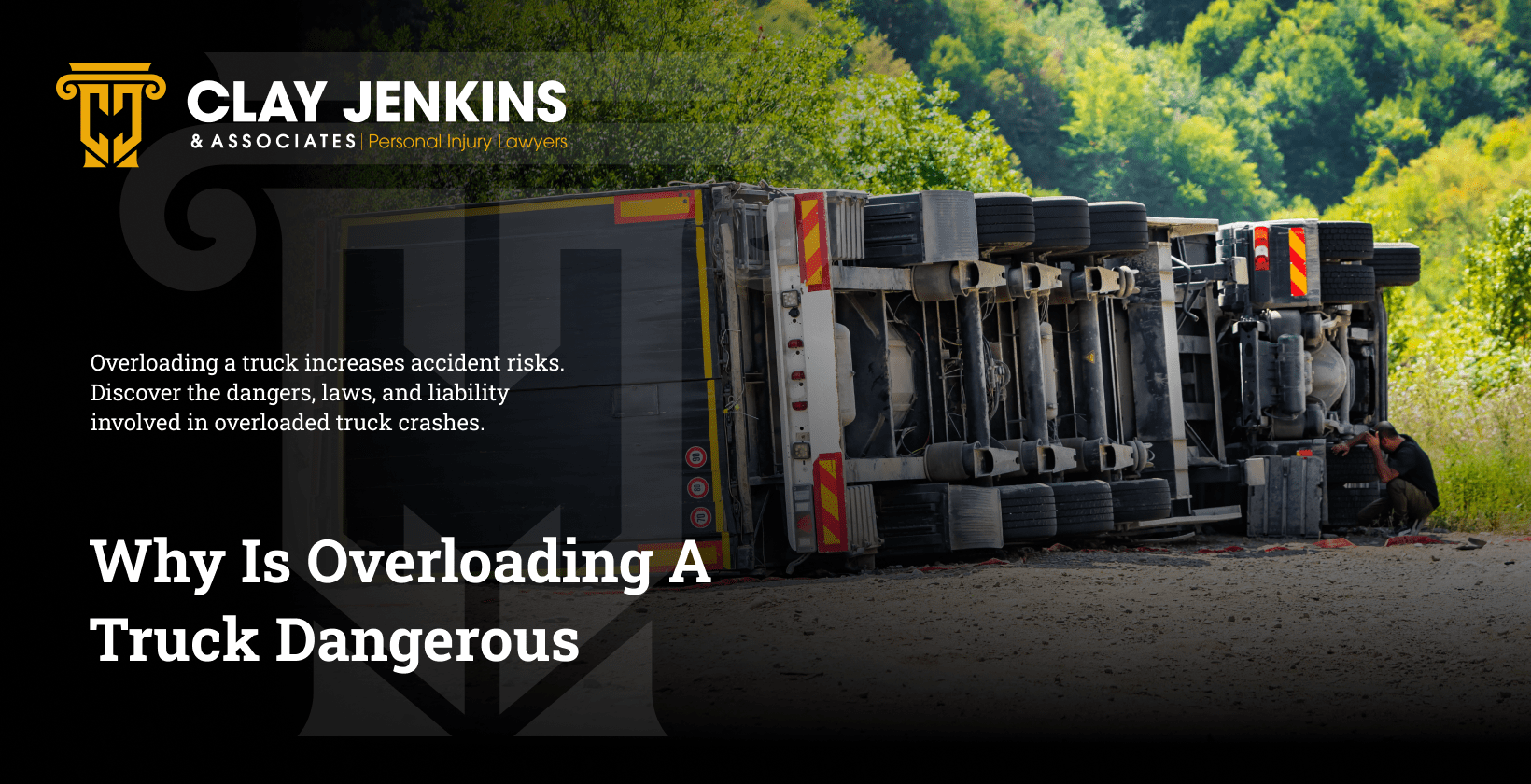
Rollover accidents caused by overloaded trucks are among the most catastrophic events that can occur on a Texas highway. Commercial trucks already have a high center of gravity compared to passenger vehicles, and excess cargo weight raises that center even further. When an overloaded truck takes a curve too quickly, changes lanes sharply, or encounters uneven pavement, the elevated center of gravity creates a strong tendency to tip over. Once a rollover begins, there is very little a driver can do to stop it. A rolling truck can crush nearby vehicles, block entire highways, and spill hazardous cargo across the roadway. Victims of truck rollovers frequently suffer traumatic brain injuries, spinal cord damage, and other severe conditions that require long-term medical care and rehabilitation.
Cargo Shifting and Loss of Control
Cargo shifting and loss of control go hand in hand when a truck is overloaded. Proper cargo securement relies on weight distribution and load balance within the trailer. When too much freight is placed inside a trailer, it becomes increasingly difficult to distribute weight evenly across all axles. During transit, cargo can shift unexpectedly due to braking, turning, or road vibrations. A sudden shift in a heavy load can move the truck’s center of gravity dramatically in a fraction of a second, causing the driver to lose directional control without warning. In some cases, cargo may break free of its restraints and spill onto the road, creating hazards for vehicles traveling behind the truck. Unsecured and improperly balanced loads are a common cause of multi-vehicle accidents and wrongful death claims in Texas trucking litigation.
Who Is Liable for Overloaded Truck Accidents?
When an overloaded truck causes an accident, multiple parties may share responsibility for the resulting injuries and damages. Identifying all liable parties is essential to pursuing full compensation for victims.
- Trucking Company: The trucking company that dispatched the overloaded vehicle can be held liable when it failed to enforce weight compliance policies or pressured drivers to carry excessive loads.
- Cargo Shipper: A cargo shipper who provided inaccurate weight documentation or knowingly loaded a truck beyond legal limits may bear direct legal responsibility for any resulting accident.
- Truck Driver: The truck driver can be held personally liable when they accepted an overloaded shipment, failed to perform required pre-trip inspections, or knowingly operated an overweight vehicle.
- Loading Company: A third-party loading company that improperly loaded or secured cargo may be independently liable when that loading error directly contributed to the crash and resulting injuries.
Regulations Designed to Prevent Overloading
Regulations designed to prevent overloading exist at both the federal and state level to protect the public from the dangers of excessively heavy commercial vehicles. The Federal Motor Carrier Safety Administration (FMCSA) sets strict weight limits and requires drivers and carriers to comply with all applicable size and weight laws. Carriers must also maintain accurate records of cargo weight, and truck drivers are required to inspect their vehicles before every trip. Texas enforces its own weight rules through roadside inspection programs and weigh stations positioned along major highways, where law enforcement checks trucks for violations in real time. Despite these measures, violations still occur regularly, and when they do, the consequences for other road users can be severe and long-lasting.
How Attorneys Prove Overloading in Cases
How attorneys prove overloading in truck accident cases requires a thorough investigation that draws on multiple sources of evidence. Because trucking companies often have legal teams working quickly to protect their interests after a crash, acting fast is critical. Attorneys handling these cases typically work to collect and preserve the following types of evidence:
- Weigh station records showing the truck’s weight at official checkpoints before the crash
- Bills of lading and shipping manifests documenting the declared weight of the cargo
- Black box data and electronic logging device (ELD) records capturing vehicle performance leading up to the collision
- Maintenance and inspection logs that reveal whether the truck’s brakes, tires, and suspension were properly serviced
- Accident reconstruction reports prepared by qualified engineers who can calculate loading conditions based on physical evidence
- Post-crash vehicle inspections examining axle wear, tire condition, and structural damage consistent with overloading
Your Legal Rights If Injured by an Overloaded Truck
Your legal rights if injured by an overloaded truck are protected under Texas personal injury law, which holds negligent parties accountable for the harm they cause. Victims may be entitled to recover fair compensation for a wide range of damages, including current and future medical expenses, lost wages, loss of earning capacity, physical pain and suffering, emotional distress, and permanent disability or disfigurement. Texas follows a modified comparative fault rule, meaning a victim can still recover compensation as long as they are found to be less than 51 percent responsible for the accident. However, any compensation awarded will be reduced by the victim’s percentage of fault. Because these cases involve multiple parties, complex regulations, and powerful insurance companies, injured victims benefit significantly from working with a knowledgeable personal injury attorney who handles commercial truck accident claims.
What Is the Maximum Weight a Semi-Truck Can Carry?
What is the maximum weight a semi-truck can legally carry depends on the type of road, the number of axles, and whether the carrier holds any special overweight permits. Under federal law and standard Texas rules, the maximum gross vehicle weight for a commercial truck operating on interstate highways is 80,000 pounds. This figure includes the weight of the truck, the trailer, and all cargo combined. Single axles are limited to 20,000 pounds, and tandem axles are capped at 34,000 pounds. In Texas, carriers may apply for overweight permits to transport heavier loads, but they must follow approved routes and conditions. Trucks that exceed these limits without proper permits are in violation of state and federal law, and any accident they cause may expose their owners and operators to significant civil liability.
How Do Police Detect Overloaded Trucks?
How police detect overloaded trucks involves a combination of fixed infrastructure and field enforcement tools. Weigh stations, also called ports of entry, are the most common method used to check commercial trucks for weight violations. Trucks are required by law to stop at open weigh stations, where they are weighed using in-ground scales. If a vehicle appears overweight, officers can direct the driver to a secondary inspection area for a more detailed check. In addition to fixed weigh stations, law enforcement agencies use portable weigh scales that can be deployed at roadside inspection sites. Certain states also use weigh-in-motion sensors embedded in highway pavement that screen trucks automatically at highway speeds. Trucks that register over legal limits are flagged for a full inspection, and drivers found in violation may be placed out of service until excess cargo is removed.
Can I Sue If an Overloaded Truck Caused My Accident?
Can a person sue if an overloaded truck caused their accident? Yes, Texas law gives accident victims the right to pursue civil claims against any party whose negligence contributed to their injuries. If an investigation reveals that a truck was operating above legal weight limits at the time of the crash, that violation can serve as powerful evidence of negligence. A victim may file claims against the truck driver, the trucking company, the cargo shipper, or any third party responsible for loading the vehicle. Damages that may be recovered include medical bills, future treatment costs, lost income, pain and suffering, and more. Texas has a two-year statute of limitations for personal injury claims, meaning victims must act within that time frame or risk losing their right to pursue full compensation. Consulting with a personal injury attorney promptly after a truck accident is strongly advisable, as evidence can disappear quickly and deadlines are strict.
Who Is Responsible When a Truck Is Overloaded?
Who is responsible when a truck is overloaded is a question that often has more than one answer, as liability in commercial trucking accidents is rarely limited to a single party. The trucking company may be responsible if it failed to establish weight compliance procedures or pressured drivers to accept oversized loads. The shipper or freight broker may bear liability if they provided false weight certifications or failed to disclose accurate cargo information. The truck driver carries a duty to verify that the load is legal before accepting a shipment. Third-party loading companies may also be found liable when improper loading or cargo securement contributed to the crash. An experienced attorney can investigate the full chain of responsibility and identify all parties whose negligence played a role.
Contact Us Today
Victims of overloaded truck accidents in Texas deserve strong legal representation from attorneys who take their cases seriously. Clay Jenkins & Associates is a personal injury law firm based in Waxahachie, Texas, serving clients throughout the state, including Dallas County. Consultations are free, confidential, and available now. The firm works on a contingency fee basis, meaning clients are not charged unless compensation is recovered.
Contact Clay Jenkins & Associates today to schedule a free consultation.
Call or text (972) 938-1234 or complete a Free Case Evaluation form